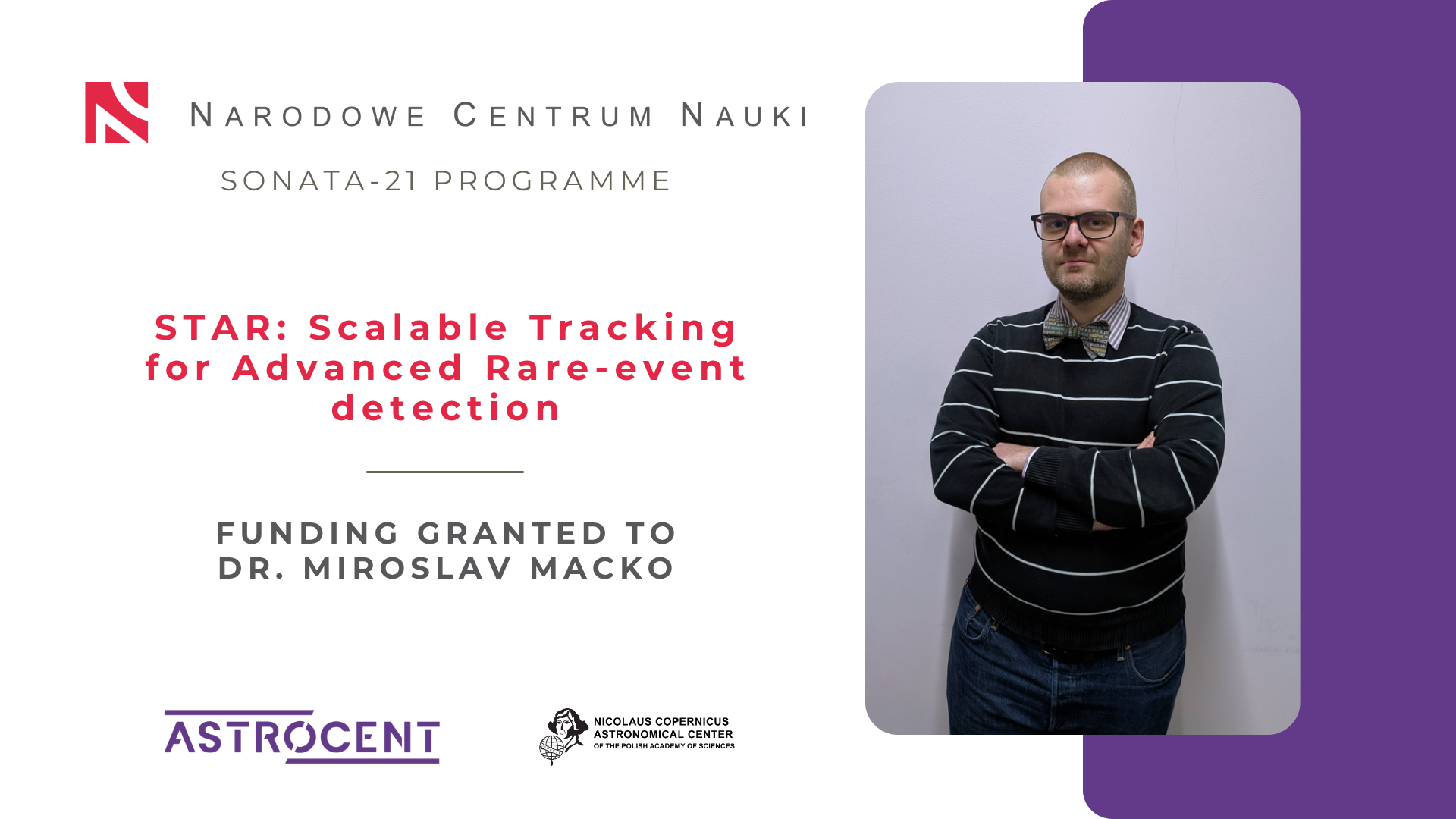
We are pleased to announce that our postdoctoral researcher, Dr. Miroslav Macko from Astrocent and the Nicolaus Copernicus Astronomical Center of the Polish Academy of Sciences (CAMK PAN) has been awarded a SONATA‑21 grant from the National Science Centre (NCN) for the project: STAR: Scalable Tracking for Advanced Rare‑event detection.
The project, funded with PLN 1 460 100, aims to develop next‑generation detector technology for the search for neutrinoless double beta decay (0νββ) – a key process that would prove that neutrinos are Majorana particles and could contribute to the explanation of the matter–antimatter asymmetry of the Universe.
The STAR project will explore an innovative combination of dual‑phase liquid‑argon TPC technology doped with xenon and the Timepix4 high‑granularity charge‑readout ASIC. This approach has the potential to deliver the scalability, energy resolution, and precise tracking required to reach sensitivities capable of probing the normal ordering of neutrino masses. The project will include detector simulations, development of track‑reconstruction software, construction of a small‑scale prototype, and demonstration of electron‑track reconstruction.
Dr. Miroslav Macko is a physicist specializing in rare‑event searches, namely neutrinoless double beta decay. Before joining CAMK PAN and Astrocent, he worked at the Czech Technical University in Prague, where he acted as deputy physics coordinator of the SuperNEMO project. He has over a decade of experience in 0νββ research, including work within the SuperNEMO collaboration, and his expertise bridges experimental particle physics, detector instrumentation, and data analysis.
Congratulations to Dr. Miroslav Macko!
Project title: STAR: Scalable Tracking for Advanced Rare‑event detection
Project budget: PLN 1 460 100
Project funded by the National Science Centre (NCN), the “SONATA 21” programme.
***Polish description***
Nazwa projektu: STAR: Skalowalne śledzenie do zaawansowanego wykrywania rzadkich zdarzeń
Kwota projektu: 1 460 100 zł
Opis projektu:
Projekt STAR będzie badał innowacyjne połączenie dwufazowej technologii ciekłego argonu TPC domieszkowanego ksenonem z układem ASIC Timepix4 o wysokiej granularności i odczycie ładunku. To podejście ma potencjał zapewnienia skalowalności, rozdzielczości energetycznej i precyzyjnego śledzenia wymaganego do osiągnięcia czułości umożliwiającej badanie normalnego uporządkowania mas neutrin. Projekt obejmie symulacje detektorów, opracowanie oprogramowania do rekonstrukcji śladów, budowę prototypu w małej skali oraz demonstrację rekonstrukcji śladów elektronów.
Projekt finansowany ze środków Narodowego Centrum Nauki w ramach programu “Sonata 21”.
#NCN #SONATA21 #ExploreTheHiddenUniverse